
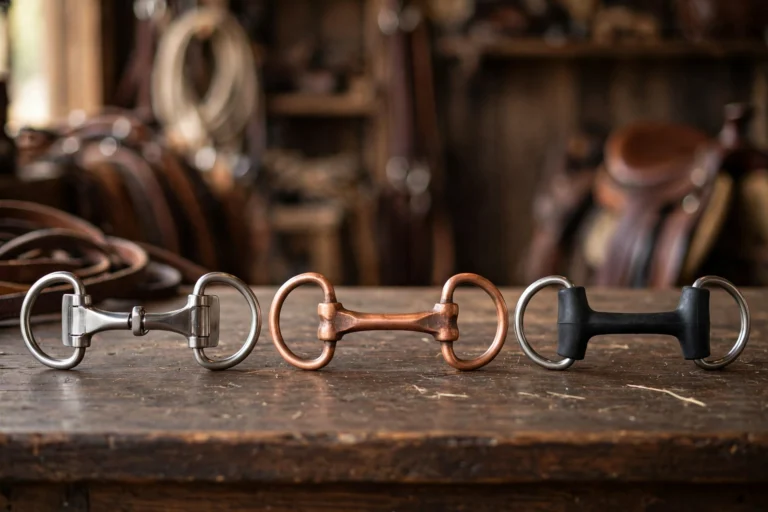
Consider a common scenario: a rider buys \a mild bit\ for a horse that leans on the forehand and gets a single-jointed loose ring — which lands on a low-palate horse, where the joint\’s nutcracker action pinches exactly the wrong place.
The short answer: Wholesale bits sell by three variables: cheek family (loose ring, eggbutt, D-ring, full cheek, hanging cheek), mouthpiece style (unjointed, single-jointed, double-jointed), and mouthpiece material (stainless, sweet iron, copper alloys, rubber or synthetic). No mouthpiece is universally milder or stronger — action depends on construction, the horse\’s mouth, and the rider\’s hands. MOQ 50 pieces per color.
This guide covers bit families, conditional material comparisons, inch sizing, competition rules, quality checkpoints, and stocking by account type. It companions our bridles, reins and halters guide (the leather tack the bit attaches to), our leather tack care guide, our pre-shipment QC checklist, and our inventory planning guide.
Key takeaways
- Stock bits by cheek family × mouthpiece style, not by a \mild to strong\ ladder — no such ladder exists independent of the horse and the hands.
- Measure size from the inside of one bit ring to the other, in inches; mouthpiece thickness and ring diameter are separate specs.
- Competition legality is a named-list discipline: USEF dressage permits only pictured bits and sets a minimum mouthpiece diameter — check the rulebook per market.
- The critical QC points are welded joints, smooth mouthpiece surfaces, free-moving rings, and symmetry. MOQ 50 pieces per color.
What are the main bit families wholesale buyers need to know?
Direct answer: English bits divide by cheek family — loose ring, eggbutt, D-ring, full cheek, hanging cheek, and leverage cheeks (pelham, kimberwick, double bridle) — each paired with a mouthpiece style: unjointed (mullen), single-jointed, or double-jointed. The cheek sets how the rein aid is delivered; the mouthpiece sets how pressure spreads across tongue, bars, and palate.
| Cheek family | Typical strengths — and under what conditions | Watch-outs — and when they show up |
|---|---|---|
| Loose ring snaffle | The standard first-line snaffle; moving rings let the mouthpiece slide, which suits horses that accept the bit readily and riders with steady hands | The rings\’ movement can pinch lip corners if the bit is sized too short — leave clearance each side of the mouth |
| Eggbutt / D-ring snaffle | Fixed cheeks give lateral guidance and a quieter mouthpiece; commonly chosen for young horses and riders still developing independent hands | The fixed cheek offers less lateral play, so it suits horses that don\’t need the bit to move much — not a cure for a horse that leans |
| Full cheek / hanging cheek | Full cheeks guide the head through turns; hanging cheeks add slight poll influence — both appear in schooling and young-horse programs | Full cheeks need keepers to keep the arms positioned; hanging-cheek upper arms must respect competition cheek-length limits where they apply |
| Double-jointed (lozenge / french link center) | The center link spreads pressure across the tongue rather than concentrating it in a single joint; a common middle ground for sensitive mouths | A thick center link can crowd a low-palate mouth — the \double-jointed is always milder\ assumption fails where mouth anatomy is tight |
| Unjointed / mullen mouth | Even pressure across tongue and bars with no joint action; suits horses that dislike joint movement | The rigid mouthpiece gives no tongue relief — a straight bar on a large-tongued horse can create its own pressure problem |
| Leverage cheeks (pelham, kimberwick, curb) | Shanked cheeks add poll and chin-groove pressure with a curb chain; serve horses and riders where direct-rein snaffles no longer suffice | Leverage multiplies the rider\’s hands — a heavy hand plus a long shank is a welfare problem; sell these to knowledgeable customers or not at all |
One point stated plainly, once: a bit is no stronger or milder than the hands holding the reins and the mouth it sits in. Wholesale catalogs sort by construction, not by a severity ladder — the ladder is a fiction the moment you change the horse.
What materials are bit mouthpieces made from, and how do they differ?
Direct answer: Four mouthpiece materials dominate wholesale lines: stainless steel, sweet iron, copper and copper alloys, and rubber or synthetic coverings — each with a different wear, taste, and maintenance story. Material changes how the mouthpiece tastes, how fast it wears, and how it needs cleaning; it does not by itself make a bit milder or stronger.
| Material | Typical strengths — and under what conditions | Watch-outs — and when they show up |
|---|---|---|
| Stainless steel | Corrosion-resistant, neutral tasting, and the longest-wearing of the metals — the workhorse of school and rental programs | The hardest surface of the common metals; durability is its argument, not softness |
| Sweet iron | Oxidizes to a rust-colored surface horses commonly accept and salivate on; popular where riders report the horse \takes the bit better\ | The oxidation is the mechanism — and the maintenance: it needs use or it pits, so it suits bits in regular work |
| Copper / copper alloys | Softer metal with a taste horses commonly accept; copper rollers appear on mouthpieces for horses that mouth the bit a lot | The softest metal of the set, so wear shows fastest — inspect for thinning at the joints; softness is not mildness |
| Rubber / synthetic covering | Soft surface over a metal or cable core; the gentlest-feeling option for sensitive or young mouths | Coverings can be chewed through, exposing the core — teach customers to retire chewed bits; an exposed cable core is a hazard |
The supplier-experience note: sweet iron and copper sell on the taste story, stainless on durability, rubber on softness. None of those stories survives a bad fit — material is the third decision, after cheek family and mouthpiece style.
How are bits sized?
Direct answer: Bit size is the mouthpiece length measured from the inside of one bit ring to the other, with the bit laid flat — in inches, normally in quarter-inch increments. Three specs are separate: the length (mouth width), the mouthpiece thickness (diameter), and the ring diameter. Confirming all three beats guessing any one of them.
Horse & Hound\’s measuring method is the one to print for customers: lay the bit flat on a hard surface over a ruler and measure inside ring to inside ring. Their guide warns against the old shorthand — mouth shapes vary too much — and notes mouthpiece thickness runs roughly 12mm to 23mm, around 16mm being the most common. A bit that measures right but is too thin or thick for the mouth\’s interdental space still fits badly; thickness is a spec, not a footnote. (Horse & Hound — How to Measure a Horse Bit)
Three wholesale sizing traps. First, loose-ring bits need clearance each side of the mouth so the rings don\’t pinch — a 5-inch loose ring is not interchangeable with a 5-inch eggbutt. Second, curved or ported mouthpieces measure differently than straight ones. Third, ring diameter is its own spec — a normal loose-ring snaffle runs around 60–70mm while a bradoon runs around 50–55mm, and mixing them up changes the rein action the customer bought.
Which competition rules affect the bits you can sell?
Direct answer: Competition bits are a named-list discipline: the rulebook pictures exactly which bits are permitted, and anything else is out. In USEF dressage, only the bits shown in the rule\’s figures and annex are permitted, snaffle mouthpieces must measure at least 10mm in diameter at the rings, and ported snaffles outside the pictured dimensions are prohibited.
USEF sets the minimum snaffle mouthpiece diameter at 10mm measured at the rings, permits unjointed, single-jointed, and double-jointed snaffles with solid center pieces, and bans twisted bits, bits with bumps, uncovered wire, and pinching designs. Ported snaffles are allowed only within the pictured tongue-relief dimensions. (USEF — Dressage Attire & Equipment Booklet)
Market \competition legal\ lines against the actual named list — the annex illustrations are the reference stewards use. And keep schooling and competition lines visibly separate: a schooling bit is not a defect, but the customer who discovers the difference at the in-gate will blame the shop.
What quality checkpoints should wholesale buyers inspect?
Direct answer: Welded joints, mouthpiece surface smoothness, ring freedom, and left-right symmetry — in that order. Bits are mouth-contact tack under load, so the checkpoints are about failure points and pinch points, not polish. A defect at any of these points is a safety issue, which is why the inspection standard stays tight.
| Checkpoint | What to look for | Why it matters |
|---|---|---|
| Welded joints | Smooth, continuous welds where rings meet the mouthpiece; no cracks, porosity, or sharp flashing | A failed weld under rein pressure is a safety event — the first inspection point on every style |
| Mouthpiece surface | Uniformly smooth along the full length; no burrs or pits at the joints; rubber coverings intact with no chew-through | Rough spots ulcerate the mouth; a chewed rubber mouthpiece hides a core that can do worse |
| Ring and joint movement | Loose rings rotate freely without catching; joints flex without grinding; eggbutt and D-ring cheeks sit square | Seized rings change the rein action silently; grinding joints wear fast and pinch |
| Symmetry and marking | Both sides mirror each other; size stamped legibly; no bent shanks or twisted mouthpieces | Asymmetric bits load one side of the mouth — and illegible size marks guarantee mis-stocked shelves |
One rejection rule worth writing into the QC agreement: bits with broken mouthpieces, cracked welds, or wire cores exposed through coverings fail outright — they do not ship with a discount, they do not ship.
How should a tack shop stock bits?
Direct answer: Stock by cheek family first, material second: loose-ring and eggbutt snaffles in stainless as the depth lines, one taste-story metal as the upgrade, and a rubber line for young-horse programs. Open each family in the middle sizes and deepen by reorder data. These are starting hypotheses — adjust by your own sell-through.
| Account type | Starting hypothesis | Watch for |
|---|---|---|
| General mixed tack shop | Loose-ring and eggbutt snaffles, stainless, middle sizes; one double-jointed line; hanging cheek as the schooling upgrade | Staff must ask about the horse\’s mouth and the rider\’s level before recommending |
| Dressage-focused shop | Deep loose-ring range including double-jointed and mullen options; competition-legal lines flagged against the current rulebook | Rule editions change — recheck the permitted-bit list when you reorder |
| Jumping / eventing shop | D-ring and full-cheek options for steering; leverage lines for the experienced customer; rubber and synthetic for the young-horse string | Leverage bits sell to knowledgeable riders — put fitting guidance on the shelf card, not just the price tag |
| Riding school / lesson barn | Stainless eggbutt and D-ring snaffles in the standard sizes; durability, smooth joints, and easy hygiene over metal variety | Schools rotate bits across horses — the clean/inspect/retire routine belongs on the school order sheet |
What specs should you confirm when requesting a quote?
Direct answer: Make the three things buyers assume explicit: cheek family, mouthpiece construction, and material — plus the size-run conventions behind them. A \5-inch snaffle\ can be several different products depending on the answers, and the quote that leaves them ambiguous is the order that arrives wrong.
- Cheek family: loose ring, eggbutt, D-ring, full cheek, hanging cheek, or leverage — named explicitly, not inferred from a photo
- Mouthpiece style: unjointed, single-jointed, or double-jointed, with center-link shape specified for double-jointed lines
- Mouthpiece material: stainless grade; sweet iron finish standard; copper alloy composition; rubber covering thickness and core material
- Sizing: length measured inside ring to inside ring in inches and millimeters per size; mouthpiece thickness per size; ring diameter per size
- Competition compliance: which rulebook lists the design is checked against, and the measured mouthpiece diameter for snaffle lines
- Joint and weld spec: weld type and smoothness standard, joint construction, ring movement tolerance
- Finish and marking: surface finish standard, size marking method and legibility, retail packaging per piece
- Colorways and MOQ: 50 pieces per color; each metal finish and each mouthpiece variant counted as a separate line for MOQ purposes
Frequently asked questions
Is there a standard \mild to strong\ order for bits?
No — not one that holds across horses. Severity is the product of mouthpiece construction, cheek action, mouth anatomy, and the rider\’s hands. Wholesale catalogs should sort by construction and teach staff to fit, not to rank.
How do I know if a bit is competition legal?
Check the rulebook for the discipline and market — for USEF dressage, only the bits pictured in the rule figures and annex are permitted, with a 10mm minimum snaffle mouthpiece diameter. Keep the permitted-bit illustrations at the counter and recheck when rule editions change.
What is the most common bit size to stock?
There is no universal answer: mouth sizes vary by breed and individual, and curved mouthpieces fit differently than straight ones at the same nominal size. Open each cheek family in the middle of its size run and let your own reorder data deepen the sizes that move.
How do you tell a worn-out bit from a usable one?
Check the failure signals: thinned or grooved metal at the joints, rough or pitted surfaces, cracked or porous welds, seized rings, and chew-through on rubber coverings exposing the core. Any of these means retirement — bits are mouth-contact tack and do not get a second life on discount.
Can the same bit factory also supply the bridle and reins?
Often yes for leather tack, but bits are metalwork — different machines, skills, and QC. A textile-and-leather supplier may subcontract bits, so verify who actually makes them and inspect to the same standard. See our supplier vetting guide for checking subcontracted lines.
Adding bits to your program? Send us your cheek families, mouthpiece styles, materials, and size runs — we quote at 50 pieces per color MOQ.
Sources & Further Reading
- USEF — Dressage Attire & Equipment Booklet (only pictured bits permitted; 10mm minimum snaffle mouthpiece diameter at rings; twisted, bumpy, wire, and pinching designs prohibited; ported snaffles limited to pictured tongue-relief dimensions)
- Horse & Hound — How to Measure a Horse Bit (inside-ring-to-inside-ring measuring; inches in quarter-inch increments; mouthpiece thickness range; ring diameter ranges; clearance guidance for loose rings)
- Bridles, Reins and Halters: A Buyer\’s Guide for Equestrian Distributors
- Leather Tack Care Products: A Distributor\’s Guide
- How to Vet an Equestrian Textile Supplier
