
Consider a common scenario: a parent buys a riding helmet online for a child\’s first lessons, choosing the glossiest, cheapest option in roughly the right size — and the helmet slides forward over the child\’s eyes at the first trot. The problem was not the price; it was that nobody checked the certification mark, the head-shape match, or whether the harness actually held the helmet in place.
The short answer: Wholesale helmets sell on certification, not styling: every helmet must pass a named safety standard (ASTM F1163 in the US, PAS 015 or EN 1384 in the UK/EU, AS/NZS 3838 in Australia) and carry the standard\’s certification mark. Fit is the maker\’s own chart, matched to head circumference and shape. MOQ 50 pieces per color.
This guide covers the standards that matter by market, helmet styles, fit and sizing, replacement rules, quality checkpoints, and stocking by account type. It companions our riding gloves guide, our safety stirrups guide, our horse boots guide, and our merchandising guide.
Key takeaways
- Certification is binary: a helmet either passes a named standard and carries the mark, or it is not a riding helmet — there is no \extra safe\ ranking among certified helmets.
- The mark proves the standard: SEI for ASTM F1163, BSI Kitemark for PAS 015, and the applicable quality mark for EN 1384 / AS/NZS 3838.
- Fit is per-maker: size by head circumference against the manufacturer\’s chart, then check head shape (oval vs round) and harness stability.
- Replace after any hard-blow impact, and follow the manufacturer\’s age guidance — helmets are consumable safety equipment. MOQ 50 pieces per color.
Which safety standards and certification marks should you require?
Direct answer: Require the standard that matches your market, and require its certification mark on the helmet — the mark is the proof. US: ASTM F1163 with the SEI mark. UK: PAS 015 with the BSI Kitemark. Europe: EN 1384:2023 or VG1 with a quality testing label. Australia/NZ: AS/NZS 3838 with the SAI Global mark.
| Standard | Certification mark | Market | What it certifies |
|---|---|---|---|
| ASTM F1163 (current edition) | SEI mark | United States | Impact attenuation (head acceleration limitation) plus strength and stability testing after temperature and moisture conditioning — SEI runs the equestrian helmet certification program (ASTM — Certifying the Standard) |
| PAS 015 (1998 or 2011, current updates) | BSI Kitemark | United Kingdom | The British riding-hat standard accepted across British Eventing, British Dressage, British Showjumping and the Pony Club |
| EN 1384:2023 / VG1 01.040:2014-12 | Quality testing label (e.g. BSI Kitemark or Inspec) | Europe | VG1 was the interim European standard; the current EN 1384:2023 edition requires a quality mark — check the edition your market\’s federation accepts |
| AS/NZS 3838 (2006 onwards) | SAI Global mark | Australia / New Zealand | The Australian/New Zealand equestrian helmet standard, listed alongside the others on Equestrian Australia\’s approved-standards page |
Equestrian Australia\’s approved-standards page is the single most useful reference for multi-market sellers: it lists every current standard with its required mark in one place, notes that manufacturers generally recommend replacing helmets every five years or so, and states that any helmet that has taken a hard blow should be replaced immediately because damage may not be visible. (Equestrian Australia — Current Approved Safety Standards for Helmets)
The wholesale rule: certification claims are verifiable, not marketing. A factory that says \meets ASTM F1163\ should produce the SEI certification for the model — the mark inside the helmet is the document, and its absence is the answer.
What are the main helmet styles, and which riders buy them?
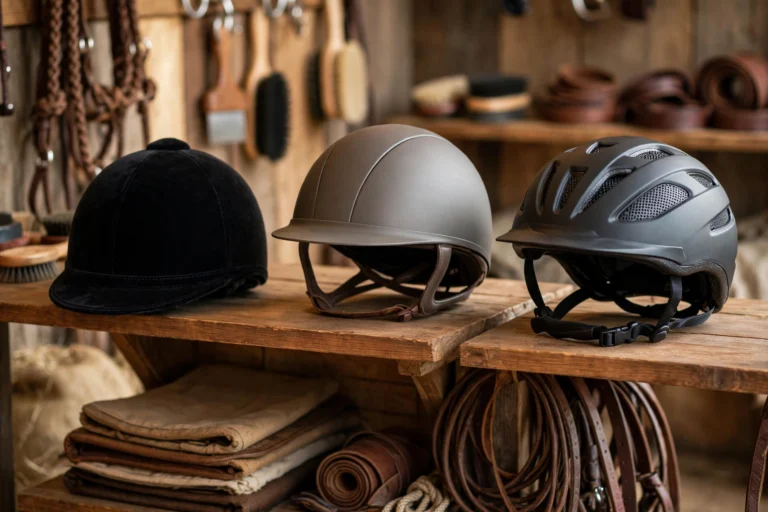
Direct answer: Three shell styles dominate retail: the traditional velvet or microfiber show helmet, the ventilated schooling helmet, and the skull cap for cross-country — plus junior and schooling lines built for price and growth. Style is a use-case decision, not a safety ranking: a certified schooling helmet protects exactly as its standard demands, same as a certified show helmet.
| Style | Typical strengths — and under what conditions | Watch-outs — and when they show up |
|---|---|---|
| Traditional show helmet (velvet / microfiber) | The classic competition look dressage and hunter riders expect; the style that photographs well and matches formal turnout | Usually the least ventilated and hardest to clean of the three — position it on appearance and tradition, not airflow |
| Ventilated schooling helmet | Airflow for daily riding and hot climates; often includes a dial-fit system; the volume line in most shops | Vents need cleaning to keep working; dial-fit mechanisms are a moving part — check the adjustment survives repeated use |
| Skull cap (cross-country) | Even round profile with no fixed peak, designed to take a silk cover; the required shape for eventing cross-country phases | Competition rules govern the shape (no peak, no protuberances) — a schooling skull and a competition skull are different compliance stories |
| Junior / schooling lines | Lower price points for lesson programs and growing children; the replacement-market driver | Growth means the fit must be rechecked regularly — sell the size-up conversation, not just the helmet |
In our experience, schooling helmets move the most units, show helmets the most margin per unit, and skull caps move with the eventing season. None of that changes which standard the helmet must pass.
How do sizing and fit actually work at the shelf?
Direct answer: Size by head circumference measured around the widest part of the head (about an inch above the eyebrows), matched against the manufacturer\’s own size chart — then check head shape and harness stability. There is no universal helmet size standard; a medium from one maker is not a medium from another, so the per-maker chart is the fitting tool.
The shelf-fitting sequence worth training staff on: measure the head, find the maker\’s chart, try the size — the helmet should sit level, cover the forehead, and feel snug without pressure points. Then check head shape: most heads run oval (longer front-to-back) or round, and a round head in an oval shell will rock no matter the circumference. Finally the harness test: fastened snugly, the helmet should not slide forward over the eyes or twist freely when the rider shakes their head — that is the test that matters at the first trot.
Three wholesale sizing traps. First, dial-fit systems adjust circumference, not shape — they rescue a slightly loose fit, they do not fix the wrong head shape. Second, children\’s helmets need rechecking as the child grows. Third, hair changes the fit: a rider who tries a helmet with hair down and rides with hair up has fitted the wrong head — train staff to ask.
When does a helmet need replacing?
Direct answer: Immediately after any hard-blow impact — a fall, a kick, a drop onto a hard surface — and on the manufacturer\’s age guidance even without an impact. The EPS liner that absorbs impact crushes once; it does not reset. Helmets are consumable safety equipment, not heirlooms.
Equestrian Australia states both rules plainly: manufacturers generally recommend replacing a helmet every five years or so, and a helmet that has taken a hard blow should be replaced at once because the damage may not be visible. That gives the tack shop an honest, repeatable replacement story: impact is the event trigger, age is the calendar trigger, and either one means a new helmet. (Equestrian Australia — Current Approved Safety Standards for Helmets)
Build the replacement cycle into the assortment: junior and schooling lines are the replacement-market engine, and the shop that records the purchase date on the receipt earns the follow-up sale. Never suggest a helmet \looks fine\ after a real impact.
What quality checkpoints should wholesale buyers inspect?
Direct answer: Certification mark, harness integrity, shell finish consistency, and ventilation function — in that order. The certification mark is the legal checkpoint; the rest decide whether the helmet survives daily use and still looks premium on the shelf after a season of use.
| Checkpoint | What to look for | Why it matters |
|---|---|---|
| Certification mark | The correct mark (SEI, BSI Kitemark, or applicable quality label) permanently labeled inside the helmet, matching the standard claimed for the target market | The mark is the certification — a helmet without it cannot be sold as meeting the standard, whatever the factory claims |
| Harness and buckle | Even stitching where straps meet the shell; buckle that fastens and releases cleanly; strap adjustment that holds its setting | The harness is what keeps the helmet on the head — the part that fails in the field is rarely the shell |
| Shell finish | Consistent color and texture across the production run; vents aligned and cleanly finished; no sharp edges at trim lines | Finish inconsistency is the most visible defect on the shelf — and sharp trim edges irritate the rider\’s forehead |
| Dial-fit mechanism (if fitted) | Smooth adjustment through its full range; holds position under vibration; no cracked or brittle plastic | A dial that slips turns a fitted helmet into a loose one mid-ride |
One rejection rule worth writing into the QC agreement: any production lot where the certification mark is missing, wrong, or illegible fails outright — it is a compliance failure, not a cosmetic one.
How should a tack shop stock helmets?
Direct answer: Stock by use case first, standard second: ventilated schooling helmets as the depth line, a show-helmet line for the competition customer, and skull caps only where the eventing customer exists. Open in the middle sizes of each maker\’s chart, confirm the certification mark, and deepen by reorder data. These are starting hypotheses — adjust by your own sell-through.
| Account type | Starting hypothesis | Watch for |
|---|---|---|
| General mixed tack shop | Ventilated schooling helmets deep in the middle sizes; one show-helmet line; junior line for the lesson-parent customer | Fit-check every sale — an un-fitted helmet is a return and a liability conversation; train the harness test |
| Dressage / hunter show shop | Show helmets deep with the traditional look; schooling line as the everyday second helmet; certified models flagged against the current federation rules | Show customers buy the look — but the certification mark still decides which models make the shelf |
| Eventing-oriented shop | Skull caps in competition-legal shapes plus ventilated schooling helmets; silk covers as the companion line | Cross-country rules govern helmet shape — stock to the current rulebook, and carry the covers riders need |
| Riding school / lesson barn | Durable schooling helmets in the full size run for the lesson string; prioritize harness durability and easy cleaning over styling | School helmets take daily abuse — the retirement rule (impact or age) belongs in the school\’s safety policy, not just the retail shelf |
What specs should you confirm when requesting a quote?
Direct answer: Make the three things buyers assume explicit: the standard, the mark, and the size system — plus the construction behind them. Two \medium black helmets\ can be different products with different legal standing, and the quote that names all three is the order that clears compliance checks.
- Certification: the named standard and edition (e.g. ASTM F1163 current edition), the certification mark carried, and the SEI or equivalent certificate per model
- Target markets: which federations\’ current rules each model is built to satisfy, and the certificate edition the factory holds
- Shell and liner: shell material and construction, EPS liner density and thickness, ventilation layout
- Sizing: the manufacturer\’s size chart in centimeters with the head-shape profile (oval / round / intermediate) each model is built on
- Harness: strap material and width, stitching spec at anchor points, buckle type and function test
- Fit system: dial-fit or pad-fit mechanism spec, adjustment range, and cycle durability of the mechanism
- Finish and colorways: shell finish standard, colorway list, consistency tolerance across the production run
- MOQ: 50 pieces per color; each shell color and each size-system variant counted per the factory\’s MOQ convention
Frequently asked questions
Is a more expensive helmet safer than a cheaper one?
Not by certification. Safety standards are pass/fail: any helmet that passes ASTM F1163 and carries the SEI mark meets the same standard regardless of price. Price buys ventilation, weight, finish, and styling — all worth paying for, but none of them changes the pass/fail result.
Can the same helmet model be sold in the US and the UK?
Only if it is certified to both standards — ASTM F1163 with the SEI mark for the US, PAS 015 with the BSI Kitemark for the UK. One standard does not imply the other; the certificate per market is what matters. Confirm the factory holds the certificates for every market you sell into.
How do I fit a helmet correctly?
Measure the head circumference about an inch above the eyebrows, match it to the manufacturer\’s chart, and check head shape — oval heads and round heads need different shells. Fasten the harness snugly: the helmet should sit level, cover the forehead, and not slide forward or twist freely when the rider shakes their head.
Does a helmet need replacing if it looks undamaged after a fall?
Yes. The EPS liner absorbs impact by crushing, and the damage is often invisible from the outside. Equestrian Australia\’s guidance is explicit: replace after any hard-blow impact, and follow the manufacturer\’s age guidance (generally around five years) even without an impact.
What is the difference between a skull cap and a regular helmet?
Shape and competition rules. A skull cap has an even, round profile with no fixed peak and takes a removable silk cover; cross-country rules require this shape with no protuberances. A regular schooling or show helmet has a fixed peak. Stock the shape the customer\’s discipline rules require.
Adding helmets to your program? Send us your target markets, standards, styles, and colorways — we quote at 50 pieces per color MOQ.
Sources & Further Reading
- Equestrian Australia — Current Approved Safety Standards for Helmets (ASTM F1163 with SEI mark; PAS 015 with BSI Kitemark; VG1 and EN 1384:2023 with quality labels; AS/NZS 3838 with SAI Global mark; replace after hard-blow impact; manufacturers generally recommend replacement around five years)
- ASTM — Certifying the Standard (SEI runs the equestrian helmet certification program to F1163; temperature/moisture conditioning; impact attenuation and strength/stability testing)
- Riding Gloves Wholesale: A Buyer\’s Guide
- Safety Stirrups Wholesale: A Buyer\’s Guide
- Saddle Pad Inventory Planning for Tack Shops
