
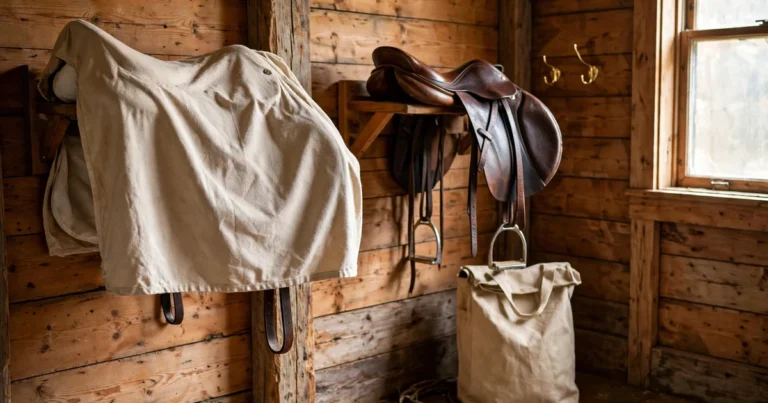
Consider a common scenario: a distributor delivers new saddles to a tack shop, and they sit on the showroom rack for weeks. Dust settles into the leather grain; a customer runs a finger along the seat and it comes away grey. In a school barn, saddles hang uncovered through a humid summer — stirrup irons scuff the seats, dust dulls the finish, mildew finds the damp corners. The saddle is the most expensive thing in the tack room, and the least protected.
The short answer: a saddle survives storage on a shaped rack, under a breathable cover, in a dry ventilated room. Cotton dust covers suit daily tack rooms; fleece covers pad long-term storage; tote bags carry saddles to shows. Never store leather under plastic covers — trapped moisture breeds mould. Confirm cover dimensions for English and Western trees. MOQ 50 pieces per color.
This guide covers what actually damages saddles in storage, the cover types a distributor should carry and how they differ, what makes a good saddle rack, how covers and racks work together in a tack room, and how to stock the category by account type. It companions our saddle pad storage bags guide (the pad-side accessory to this saddle-side one), our leather tack care guide (clean before you store), our merchandising guide (presenting accessories), and our buying calendar (when storage lines move).
Key takeaways
- Storage damage is dust, sunlight, scratches, moisture, and shape distortion — covers and racks each solve different parts of the list.
- Breathable covers protect; plastic or waterproof covers stored long-term invite mould. Cotton is the default for daily tack-room covers.
- Racks preserve the tree\’s shape — saddles should rest shaped, off the ground, never stacked or hung by their stirrup leathers.
- English and Western trees need different cover dimensions; confirm against real saddles, not generic S/M/L.
- Attach a cover to every saddle sale — it is the most natural accessory upsell in the shop. MOQ 50 pieces per color.
What actually damages a saddle in storage?
Direct answer: Dust and grime settling into the leather grain, sunlight fading and drying the finish, scratches from stirrup irons and neighboring tack, moisture and mould in damp rooms, and shape distortion from bad racking. Most of this is slow and invisible until the saddle looks tired — which is exactly when a buyer decides against it.
| Risk | How it happens | What prevents it |
|---|---|---|
| Dust and grime | Airborne dust settles on uncovered saddles in tack rooms and showrooms, dulling the finish | A breathable cover over the saddle between uses |
| Sunlight | Direct sun and strong fluorescent light dry leather and fade color over time | Store shaded; covers block the light that racks don\’t |
| Scratches | Stirrup irons against the seat, saddles crowded on shared racks, trailer loading | Run stirrups up or remove leathers; padded covers; one saddle per rack position |
| Moisture and mould | Damp rooms and sealed covers trap the humidity mould needs | Dry, ventilated room; breathable covers only; dry the saddle before covering |
| Shape distortion | Saddles stacked, hung by leathers, or left on flat surfaces that don\’t support the tree | A shaped rack that carries the tree, off the ground |
Carr & Day & Martin\’s tack-care guidance backs the room-and-rack fundamentals: saddles should sit on saddle racks to preserve their shape, stored off the ground in a dry room at a consistent temperature with good ventilation, protected from direct sunlight — and covers should be breathable, with cotton the ideal material, never plastic or waterproof covers for storage, because sealed covers create the moist conditions that attract mould (Carr & Day & Martin — Essential Guide to Caring for your Tack). That last point is the single most load-bearing rule in this category: a cover that can\’t breathe is worse than no cover at all in a damp room.
Which saddle cover types should a distributor carry?
Direct answer: Carry three lines: a breathable cotton dust cover for everyday tack-room use, a fleece or padded cover for long-term storage and extra protection, and a tote or carry bag for transport to shows and clinics. Waterproof rain covers are a fourth, separate product — for riding out in rain, not for storing. No one cover does all four jobs.
| Cover type | Typical strengths — and under what conditions | Watch-outs — and under what conditions |
|---|---|---|
| Breathable cotton dust cover | Keeps dust and light off daily-use saddles; cotton lets air move, which is what leather needs in storage | Thin cotton won\’t cushion bumps; dark rooms or heavy dust may call for a heavier weave — write the fabric weight into the spec |
| Fleece / padded cover | Extra cushioning against knocks for saddles stored long-term or crowded in a busy tack room; soft inner face won\’t mark leather | Heavier and bulkier; some fleece faces hold dust themselves — check the inner face material, not just the padding claim |
| Saddle tote / carry bag | Handles and a shoulder strap for the walk to the arena; contains stirrups and girth straps in transit; the show-day product | A tote is transport, not storage — don\’t leave a saddle zipped in one for weeks in a damp room |
| Waterproof rain cover | Shields the saddle from rain during riding and outdoor standing — Carr & Day & Martin recommend a waterproof cover for exactly this job | Never use as a storage cover: the same waterproofing that sheds rain traps moisture against leather in the tack room |
The waterproof-cover distinction trips buyers up: the same Carr & Day & Martin guide that warns against plastic covers for storage recommends a waterproof cover against rain. Both are true because the jobs differ — rain protection is hours, storage is months. Spec and sell them as separate products, and put one line on the rain cover\’s hang tag: remove after the ride.
What makes a good saddle rack?
Direct answer: A good rack carries the saddle by its tree on a shaped, padded surface, holds it level and off the ground, and fits the tree family it serves. Wall-mounted suits permanent tack rooms; freestanding suits showrooms; folding suits shows and clinics. Confirm rated load in writing — a Western saddle weighs substantially more than an English one.
| Rack type | Where it fits | What to check |
|---|---|---|
| Wall-mounted | Permanent tack rooms and showrooms; keeps floor space clear | Mounting hardware and wall anchoring; arm shape under the tree; padding on the contact surface |
| Freestanding | Showrooms, temporary tack rooms, barns without suitable walls | Base stability when a saddle is lifted on and off; footprint vs available floor space |
| Folding / portable | Shows, clinics, schooling days; the mobile product | Hinge and lock strength; whether it stands level on uneven ground; packed size for the trailer |
Three rack details decide real-world satisfaction. First, contact-surface shape: an arm that mirrors the tree\’s curve supports the saddle; a flat board or bare metal arm concentrates load and can mark panels — padding on the contact surface is cheap insurance. Second, tree-family fit: a rack shaped for one tree won\’t cradle the other — specify which family each rack serves. Third, spacing: crowded saddles scratch each other with irons and D-rings, so plan one saddle per rack position.
How do covers and racks work together in a tack room?
Direct answer: Clean the saddle, let it dry completely, set it on its shaped rack, then pull the breathable cover over it. Keep saddles off the ground and the room ventilated, and check stored tack periodically. The sequence matters: a cover over a damp saddle, or a rack in a sealed damp room, undoes the good the other parts do.
The workflow is a chain, and each link has a condition. Leather must be completely dry before covering — Horseman\’s News is explicit that tack should be fully dry before storing, in a well-ventilated area with consistent temperature and no direct sunlight (Horseman\’s News — The Art of Cleaning and Storing Tack). On the rack the saddle rests shaped and level; the cover goes over last, keeping dust and light off while the cotton breathes. For long-term storage, Carr & Day & Martin add the discipline: clean thoroughly first, protect, and check periodically — stored tack is not forgotten tack.
For the busy tack room, this workflow is also the selling story: a rack per saddle, a cover per rack, and a cleaning routine before both. Distributors who sell racks and covers as a set — with the workflow printed on a card — give shops a system instead of two SKUs, and systems reorder more predictably than loose accessories.
How should a tack shop stock the saddle-storage category?
Direct answer: Stock covers and racks as the saddle\’s companion line: a breathable dust cover in the shop\’s colors, one padded or fleece option, tote bags for show customers, and racks matched to the saddles on the floor. Attach a cover to every saddle sale — in our experience the most natural accessory upsell. Open narrow; deepen by reorder data.
The category economics favor the attach sale: a saddle buyer is at peak willingness to protect the purchase, and a cover offered at the register converts more reliably than one discovered on a wall weeks later. That is supplier experience, not a measured rule — but it shapes the assortment: keep dust covers near the saddles, and train staff to offer one with every saddle.
| Account type | Starting hypothesis | Watch for |
|---|---|---|
| General tack shop | Cotton dust covers in black and navy; one fleece cover option; tote bags; wall racks for the saddle wall | Cover colors track the shop\’s saddle colors; racks reorder when the saddle wall expands |
| Show-focused shop | Show-presentation covers (clean lines, subtle branding); padded travel totes; portable racks for the show string | Show season drives totes and portable racks; order ahead of the calendar |
| Riding school / lesson barn | Durable dust covers in dark colors; sturdy wall racks, one per saddle; fewer totes | Schools replace on wear and loss — steady, unglamorous reorders, not seasonal spikes |
One honest boundary: this category complements our saddle pad storage bags guide — that article covers pad storage; this one covers the saddle itself. Cross-merchandise where customers overlap, but don\’t blur the lines: a pad bag doesn\’t protect a saddle, and a saddle cover doesn\’t protect a pad.
What specs should you confirm when requesting a quote?
Direct answer: Cover quotes go wrong on dimensions and fabric weight; rack quotes go wrong on tree fit and construction. The checklist below separates a quotable spec from a guess.
- Cover dimensions per size, keyed to English and Western tree families — confirmed against real saddles
- Cover fabric: fiber, weight, weave — written as a full spec, not just \cotton\ or \fleece\
- Breathability confirmation: no plastic or waterproof membranes on storage covers
- Fleece/padded covers: inner-face material and padding type, so the soft side is the one touching leather
- Tote bags: handle and strap hardware, stitching, and whether stirrups fit inside
- Racks: tree-family fit, contact-surface shape and padding, mounting hardware, rated load in writing
- Logo: embroidery or print, placement, size — locked before quoting
- Colorways and MOQ: 50 pieces per color per cover colorway; rack finishes per finish
Frequently asked questions
Can one cover fit both English and Western saddles?
No — the tree profiles differ enough that a cover cut for one fits the other badly: too tight across a Western swell, or swimming on an English saddle. Carry both lines, and size each cover family against real saddles of that family before quoting. The rack question is the same: specify which tree family each rack serves.
Are fleece covers better than cotton covers?
Neither is universally better — they do different jobs. Cotton dust covers suit daily tack-room use: light, breathable, easy to wash. Fleece or padded covers suit long-term storage and crowded tack rooms where knocks are the risk. Many buyers carry both and let the use case, not a ranking, decide.
Will a cover prevent mould?
No cover prevents mould on its own. Mould prevention is dry leather, a dry ventilated room, and periodic checks — the cover\’s job is to keep dust and light off while letting air move. The rule runs one way: a breathable cover is safe; a plastic or waterproof cover in long-term storage actively invites the moisture mould needs.
Can saddle covers carry a shop logo?
Yes — the broad side panel of a dust cover or tote takes embroidery or print well, and a branded cover advertises in every barn aisle. Keep the logo off high-wear areas like handles and straps. Lock logo size, placement, and method before quoting; see our branding guide for method trade-offs.
Should stirrups stay on the saddle under the cover?
A common tack-room practice is to run stirrups up or remove the leathers before covering, because iron scuffs on seats and panels are among the most frequent cosmetic complaints on stored saddles. Whichever your accounts prefer, size the cover for it — a cover spec\’d with stirrups up differs from one spec\’d with leathers removed.
Adding saddle covers and storage to your program? Send us your saddle types by tree family — we quote breathable dust covers, fleece covers, tote bags, and racks with your logo at 50 pieces per color MOQ.
Sources & Further Reading
- Carr & Day & Martin — Essential Guide to Caring for your Tack (saddles on racks to preserve shape; breathable cotton covers preferred; no plastic/waterproof covers for storage; dry ventilated room)
- Horseman\’s News — The Art of Cleaning and Storing Tack (tack completely dry before storing; saddle racks to maintain shape; breathable covers; periodic checks)
- Saddle Pad Storage Bags Wholesale
- Leather Tack Care Products: A Distributor\’s Guide
