
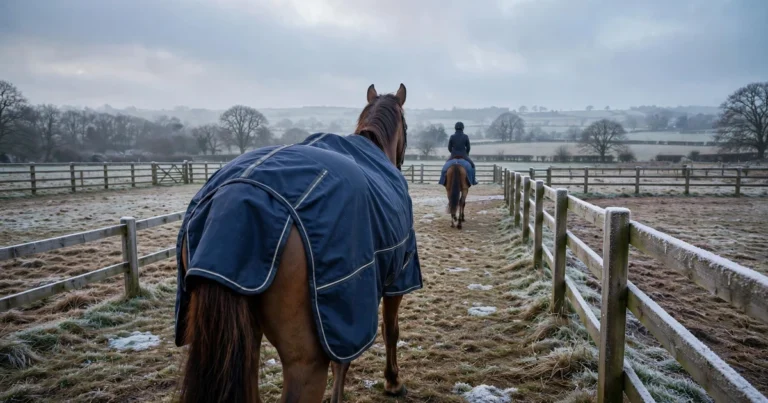
Consider a common scenario: a rider keeps a horse clipped through winter and schools on cold mornings. Between warm-up and real work, the horse\’s back cools and stiffens — the rider wants cover that stays on while riding. That is the exercise sheet\’s job: a rug family worn under or over the saddle during work, protecting the large muscle groups while the rider\’s leg stays in contact.
The short answer: an exercise sheet covers the back and quarters while being ridden; a quarter sheet is the shorter, quarters-only version. Distributors carry three builds — waterproof fleece-lined for winter, unlined fleece for dry cold, mesh or hi-viz for summer — in under-saddle, wrap-around, and full-coverage cuts. Size by measured back length against the maker\’s chart. MOQ 50 pieces per color.
This guide covers the exercise sheet versus quarter sheet distinction, the cut and attachment styles wholesale buyers will see on factory spec sheets, which fabrics suit which riding weather, how sheet sizing actually works, and how to stock the category by account type. It companions our horse blankets and turnout rugs guide (the standing-rug side of the range), our coolers guide (the after-work drying rug), our fly sheets guide (summer protection), and our buying calendar (when rug categories peak).
Key takeaways
- Exercise sheets are the full-length ridden rug; quarter sheets cover the quarters only — sell both cuts, because riders choose by coverage.
- Attachment decides satisfaction: girth loops for under-saddle sheets, touch-tape fronts for wrap-around sheets, tail cords against wind lift.
- Fabric follows weather, not fashion: waterproof fleece-lined for wet winter, unlined fleece or wool for dry cold, mesh or hi-viz for summer riding.
- Sheet sizes run on measured back length — always quote against the maker\’s own chart.
- One line serves three seasons with waterproof, fleece, and mesh variants — order as a family. MOQ 50 pieces per color.
What is an exercise sheet — and how is a quarter sheet different?
Direct answer: An exercise sheet is a rug worn during riding to keep the horse\’s back and quarters warm: it runs from the withers or shoulder to the tail, with a cut that works around or under the saddle. A quarter sheet is the shorter member of the same family — it covers the quarters (hindquarters) only, typically starting behind the saddle. Retailers also sell both under the name \ride-on rug.\ The distinction is coverage length, not a separate technology.
Horse & Hound\’s exercise sheet buying guide describes the family\’s three basic designs: some sheets fit under the saddle, others wrap around it for convenience, and some cover the saddle completely — many with a cutaway front so the rider keeps leg contact, and most secured with touch-tape fastenings (Horse & Hound — Best Exercise Sheets for Horses). That design variety is exactly what a distributor\’s line needs to cover: one cut does not suit every rider\’s preference for how the sheet relates to the saddle.
The naming matters for wholesale communication. On factory spec sheets you will see \exercise sheet,\ \quarter sheet,\ and \ride-on rug\ used loosely — sometimes for the same cut. Lock the naming in writing on the tech pack: name the style by its cut (under-saddle, wrap-around, full-coverage) and its coverage length, so factory and buyer mean the same thing.
Which cut and attachment styles do wholesale buyers need to know?
Direct answer: Three cuts dominate wholesale lines: the under-saddle sheet held by girth loops, the wrap-around ride-on sheet fastened at the front with touch-tape and cut away at the girth, and the full-coverage sheet that goes over horse and saddle together. Each needs its own stay-put hardware — girth loops, a fillet string or tail cord, and, on some styles, a wither fastening.
| Cut | How it sits | Typical strengths — and under what conditions | Watch-outs — and under what conditions |
|---|---|---|---|
| Under-saddle sheet | Lies under the saddle, secured by girth loops | Simplest fitting; the sheet can\’t slide back because the girth holds it; suits riders who want maximum saddle stability | The rider\’s leg sits over the sheet — some riders dislike the extra layer; the sheet must be thin enough not to disturb saddle fit |
| Wrap-around ride-on sheet | Fastened at the front with touch-tape, wraps around the saddle, cut away at the girth for leg contact | Quick on and off without removing the saddle; the cutaway front keeps the rider\’s leg against the horse — the most common retail design in Horse & Hound\’s guide | Touch-tape clogged with hair loses grip — a care note worth printing on the hang tag; wind can lift the back without a tail cord |
| Full-coverage ride-on sheet | Covers horse and saddle together in one contoured piece | Maximum weather protection for the rider\’s tack as well as the horse; popular for hacking in rain | The bulkiest cut to pack and carry; some riders find full coverage too warm for harder work — position it as the foul-weather option |
Hardware details decide whether a sheet stays put in trot and canter. Girth loops must sit on the maker\’s girth line — misplaced loops let the sheet creep. A fillet string or braided tail cord stops the back edge lifting in wind; write its attachment method into the spec, not just its presence. On wrap-around styles, the touch-tape front closure takes the strain every time the sheet goes on — specify the tape grade and the stitched reinforcement behind it.
Which fabrics suit which riding weather?
Direct answer: Match the fabric to the riding weather, not to a quality ladder: waterproof and breathable shells with fleece lining for wet winter work, unlined fleece or wool for dry cold, lightweight mesh or hi-viz fabrics for summer riding, and showerproof unlined shells for the mild-wet shoulder season. No single fabric is \best\ — the wrong fabric for the conditions is the one that comes back.
| Fabric build | Typical strengths — and the conditions they depend on | Watch-outs — and when they show up |
|---|---|---|
| Waterproof shell + fleece lining | Keeps rain out and warmth in during winter hacking and schooling; the fleece wicks light sweat. Horse & Hound\’s reviewers consistently rate this build the winter default. | Heaviest and warmest of the family — in hard work or mild weather the horse can overheat; confirm breathability claims against a test, not a label word. |
| Unlined fleece / wool | Light, breathable warmth for dry cold days; wicks moisture well; the classic schooling sheet. | No rain protection at all — one shower undoes the job; wool holds water weight when soaked, so position it for dry conditions honestly. |
| Waterproof unlined / rain sheet | Light rain protection without added warmth; packs small; the mild-wet-day option. | Without insulation it is only a rain layer — buyers who expect warmth from it will be disappointed; keep the copy honest. |
| Mesh / hi-viz summer sheet | Airflow and visibility for summer hacking; doubles as light fly protection; the road-safety product Horse & Hound groups separately for a reason. | Zero warmth and minimal rain protection — sell it as a visibility and airflow product, never as weather protection. |
Two fabric claims need wholesale discipline. First, \waterproof\ versus \water-resistant\: a waterproof shell with sealed or well-constructed seams behaves differently from a showerproof coating that wets out in sustained rain — write the shell\’s actual construction into the spec. Second, breathability: a waterproof sheet that doesn\’t breathe becomes a sweat trap beyond a walk, which is why the fleece lining\’s wicking role matters as much as the shell. Neither claim can be verified from a swatch photo.
How do quarter sheet and exercise sheet sizes work?
Direct answer: Sheet sizes run on measured back length — the distance the sheet must cover behind the withers — not directly on the horse\’s turnout rug size. Use the horse\’s rug size only as a rough starting reference, then size against the maker\’s own chart.
Harry Hall\’s quarter sheet size guide shows the pattern: sizes are keyed to the horse\’s rug size band (Pony 5\’3\–5\’6\, Cob 5\’9\–6\’0\, Full 6\’3\–6\’6\, XFull 6\’9\–7\’0\) with an approximate back measurement for each — 63, 69, 77, and 85 cm respectively (Harry Hall — Waterproof Quarter Sheet Size Guide). Treat those figures as that maker\’s convention, not an industry standard: another factory\’s \Full\ can cover a different back length, and the quarter sheet\’s coverage length is more sensitive to a few centimetres than a turnout rug\’s is, because there is no belly surcingle to take up slack.
Three sizing points belong in the wholesale conversation. First, coverage position: a quarter sheet that is too long drapes over the tail and catches the leg aids; one too short leaves the quarters exposed — the useful length is set by where the sheet sits relative to the saddle\’s cantle. Second, imperial versus metric versus S/M/L naming: makers mix all three, so the tech pack should carry the real measured dimensions in centimetres. Third, confirm the chart in the sampling round: measure the sample against a real horse in the target size band before approving bulk.
How should a distributor stock the exercise-sheet category?
Direct answer: Stock the category as a small family, not a single SKU: one waterproof fleece-lined winter sheet, one unlined fleece or wool sheet for dry cold, and one mesh or hi-viz sheet for summer — in the cut mix your accounts prefer, with sizes weighted to the middle of the chart. Open narrow, deepen by reorder data.
The category\’s economics reward the family approach. A shop that carries only the winter waterproof sheet loses the summer visibility sale; a shop that carries all four builds in the core sizes gives riders a reason to return when the season changes. That said, the opening order should stay narrow: the three builds above in the central sizes, with edge sizes and fashion colors added on reorder evidence.
| Account type | Starting hypothesis | Watch for |
|---|---|---|
| General tack shop | Waterproof fleece-lined wrap-around as the anchor; unlined fleece second; mesh hi-viz for the hacking customers | Cut preference is regional — some markets default to under-saddle sheets; check before committing the cut mix |
| Show-focused shop | Presentation-friendly dark colors; fleece exercise sheets for warm-up rings; fewer hi-viz SKUs | Show customers buy sheets for warm-up, not hacking — coverage and neat fit matter more than reflectivity |
| Riding school / livery yard | Durable waterproof sheets in dark colors; simple under-saddle cuts that fit many horses | Schools buy for function across many horses — easy washing and forgiving fit beat fashion; steady replacement reorders |
Order timing follows the rug calendar: winter sheets sell from autumn, so bulk needs to land before the cold-weather riding season — confirm the production window per order rather than assuming a fixed calendar.
What specs should you confirm when requesting a quote?
Direct answer: Sheet quotes go wrong on three things: the cut name (factory and buyer picturing different styles), the coverage length per size, and the fabric build actually supplied. The checklist below pins all three down before pricing.
- Cut name locked in writing: under-saddle, wrap-around ride-on, or full-coverage — with a sketch or photo, not just the words
- Coverage length per size in centimetres, measured from a stated reference point
- Shell fabric: fiber, weight, weave, and the waterproof/breathable construction — not just \waterproof\
- Lining: fleece weight and type, or unlined — stated explicitly
- Attachment hardware: girth-loop webbing and placement, touch-tape grade, tail cord material and fixing
- Reflective elements: piping or strips — placement and whether they are sewn in or heat-applied
- Colorways and MOQ: 50 pieces per color per cut; confirm whether the MOQ applies per size run or per color across sizes
- Packing: folded or rolled, individual polybag, carton quantity
Frequently asked questions
Can an exercise sheet double as a cooler?
Partly, but not as a rule. An unlined fleece exercise sheet wicks moisture and can serve as a light cooler after work on a dry day. A waterproof fleece-lined sheet traps too much heat for post-exercise cooling — sell the two jobs as separate products.
Does the sheet go under or over the saddle?
Both exist — that is the cut distinction, not a fitting mistake. Under-saddle sheets lie beneath the saddle on girth loops; wrap-around and full-coverage sheets go over or around it. Stock the cut your accounts ask for, and train staff to explain the difference, because a rider who expects one and receives the other will return it.
Will a quarter sheet stay in place at trot and canter?
It should, if the attachment is right: girth loops on the correct line for under-saddle styles, a secure touch-tape front and a tail cord or fillet string on wrap-around styles. Movement complaints usually trace to a sheet sized too generously or hardware placed off the girth line — both are spec issues, not rider issues.
Are \waterproof\ exercise sheets really waterproof?
Only as waterproof as their shell construction and seam treatment. A coated fabric that wets out in sustained rain is showerproof, not waterproof — ask the factory for the test description behind the word, and keep the retail copy honest. The distinction matters because a buyer caught in rain remembers exactly which word was on the tag.
Can exercise sheets carry a shop or brand logo?
Yes — the quarter panel is a broad, flat embroidery surface and one of the most visible logo placements in the rug category. Keep logos off the touch-tape zones and high-friction edges. Lock logo size, placement, and method before quoting; see our branding guide for method trade-offs. MOQ 50 pieces per color applies per logo colorway.
Adding exercise sheets to your program? Send us your target cuts, sizes, and colorways — we quote waterproof, fleece, and mesh builds with your logo at 50 pieces per color MOQ.
Sources & Further Reading
- Horse & Hound — Best Exercise Sheets for Horses (three design families: under-saddle, wrap-around, full-coverage; cutaway fronts; touch-tape fastenings; waterproof/breathable shells; fleece linings; girth loops and fillet strings; hi-viz options)
- Harry Hall — Waterproof Quarter Sheet Size Guide (size bands by rug size with approximate back measurements: Pony 63 cm, Cob 69 cm, Full 77 cm, XFull 85 cm; reflective strips; fleece lining)
- Horse Blankets and Turnout Rugs: A Distributor\’s Guide
- Horse Coolers and Anti-Sweat Sheets: A Distributor\’s Buying Guide
- Horse Fly Sheets and Fly Masks: A Seasonal Buyer\’s Guide
- The Tack Shop Buying Calendar
