
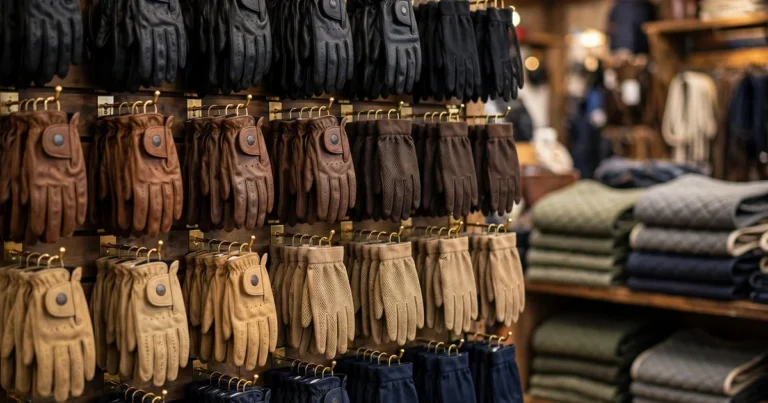
Consider a common scenario: a tack shop builds a small glove wall — leather, synthetic, and mesh side by side. The mesh gloves sell out in the first warm month, then a few pairs come back from riders who bought a size too small because the shop offered no measuring guidance. The leather gloves sit quietly until show season, then sell steadily. Gloves are a small-ticket line, but the returns and the reorders behave differently from pads — and sizing is where most of the trouble lives.
The short answer: riding gloves come in three builds: leather, synthetic suede, and mesh. Stock all three, not one. Measure around the hand\’s widest part, excluding the thumb; read each maker\’s own size chart; and mind the US/EU numbering gap. Choose grip and stitching for the riding style — then let reorder data, not assumptions, set size depth. MOQ 50 pieces per color.
This guide covers the three glove builds and their trade-offs, how to measure and why size charts disagree, grip and stitching checks, the competition color rules that shape show-season stocking, and assortment building by account type. It companions our inventory planning guide, our buying calendar, our merchandising guide, and our branding guide.
Key takeaways
- Leather, synthetic, and mesh are three different jobs, not a quality ranking. Match the build to the riding use.
- Glove sizes are not universal: measure the hand around its widest part excluding the thumb, then read the specific maker\’s chart — US and EU numbering differ.
- Grip and stitching decide daily usefulness; even stitching, flat seams, and a working wrist closure beat decorative details.
- Competition rules shape color stocking: white or light gloves are recommended in US dressage, with stricter color requirements at FEI levels.
- Start assortments narrow by shop type, then deepen sizes and colors by reorder data. MOQ 50 pieces per color.
What are the three glove builds a distributor should stock?
Direct answer: Leather gloves for feel and tradition, synthetic-suede gloves for washability and value, and mesh-backed gloves for hot-weather airflow. None is universally best: leather suits riders who prioritize rein feel, synthetics suit daily-use and lesson barns that machine wash, and mesh suits warm climates and heavy sweating. Stock all three, weighted to your customer base.
Every glove is a compromise between feel, durability, weather behavior, and price. Leather transmits the most through the rein but needs care and costs more to make. Synthetic suede — the microfiber palm on most schooling gloves — trades some of that feel for washability and lower cost. Mesh backs vent heat but add seams that wear faster in heavy use. The table below frames each build by the conditions where it fits, not by a fixed ranking.
| Build | Typical strengths — and under what conditions | Watch-outs — and under what conditions | Typical buyer |
|---|---|---|---|
| Leather (goatskin, deerskin) | Close rein feel; conforms to the hand with wear; classic show-ring look | Needs cleaning and conditioning; loses grip when soaked; higher cost; sizes can drift as leather gives with wear | Show riders, dressage and hunter accounts, traditional tack shops |
| Synthetic suede | Machine-washable on many styles; consistent fit out of the bag; strong value for the price | Less nuanced rein feel; palm can pill or thin with heavy daily use; heat builds up on solid-back styles | Lesson programs, schooling riders, price-conscious shops |
| Mesh back | Ventilation in heat; light weight; popular where summers are long | Mesh snags and tears more easily; less support for the hand; not the show-ring look in most disciplines | Warm-climate shops, trail and endurance riders, summer assortments |
Two specification cautions. First, \leather\ is not one thing: animal, tannage, and thickness decide the glove, so name the leather type in the tech pack rather than writing \genuine leather\ and hoping. Second, don\’t judge a glove by its back-of-hand styling alone — the palm is the working surface, and two gloves with identical backs can have completely different palms. Evaluate the palm first.
How do you measure for glove size — and why do charts disagree?
Direct answer: Wrap a tape around the hand at its widest part, excluding the thumb. Read the measurement against the maker\’s own chart. Charts disagree because US and EU makers number differently, and because lasts — the hand forms gloves are built on — differ between brands. Always read the chart of the brand being ordered.
The measuring method is nearly universal — SSG\’s published guidance says to measure around the hand at the widest part, excluding the thumb, and convert the reading on the chart provided with the glove (Old Mill Saddlery\’s SSG All Weather page shows the method and the brand\’s own table). Where buyers trip is assuming that method gives the same number everywhere. It doesn\’t: Heritage Gloves, a US maker, notes European companies measure \in a completely different way\ on the metric system, and publishes a USA-to-EU conversion chart — a US 7 is an EU 6.5, a US 9 an EU 8, and so on (Greenhawk\’s Heritage Gloves sizing page). Order US 8 against a Euro chart and the glove will be wrong.
Practical rules for wholesale: hang the measuring method beside the glove display, reference each brand\’s chart rather than a generic one, and tell staff what to do at a between-size reading — measure both hands and fit the larger, and round as the maker\’s chart directs. Leather typically gives a little with wear, so a snug-but-not-tight reading is the safer starting point in our experience — though the maker should confirm for the specific leather. Children\’s gloves follow the same measuring method on smaller lasts; don\’t scale adult charts down and guess.
What should you check in grip, palm and stitching?
Direct answer: Check the palm material for the riding it will do, silicone or textured grip prints for where they actually help, seam placement for comfort, stitch evenness for durability, and the wrist closure for a working fit. A glove that fails on any of these is a return; a glove that excels on all of them is a reorder.
The palm is the working surface, and grip aids are conditional tools. Silicone or rubberized prints help most where the rein meets the fingers — wet reins, long schooling sessions — and matter least when hands and reins stay dry. Textured synthetic palms sit in the middle: more grip than smooth leather, less than a full silicone print. None of these replaces correct sizing: an oversized glove with grip print still slides, and an undersized one still binds.
Stitching is the durability story: even stitch length, no skipped stitches, no loose thread ends, reinforcement where fingers meet the palm. Seams placed on the outside of the fingers reduce pressure points on the rein hand — worth specifying for sensitive hands. The wrist closure should shut snugly without a gap that lets the glove twist. On samples, cycle every closure repeatedly; a closure that weakens in the showroom will fail in the barn.
| Check | What good looks like | Why it matters |
|---|---|---|
| Palm material | Even thickness, no thin spots, grip print (if any) aligned to fingers | Thin spots become holes; misaligned print grips nothing |
| Stitching | Even stitch length, no skips, reinforced finger-palm junctions | Skipped stitches are the first failure on working gloves |
| Seam placement | Smooth inside the fingers; minimal bulk at fingertip seams | Internal seam ridges chafe on long rides |
| Wrist closure | Closes snugly, survives repeated open-close cycles | A failed closure means a glove that twists on the hand |
| Care behavior | Wash instructions on the label; wash one sample before bulk | Synthetics that claim washability should prove it before the order |
Do competition rules restrict glove color?
Direct answer: In US dressage, white or light colored gloves are recommended and any solid color is permitted at Fourth Level and below; gloves are required at FEI levels and must be white, off-white, or the coat color. Confirm the current rulebook before planning show-season stock — the pattern holds: conservative colors for the show ring, anything goes for schooling.
The USEF Dressage Attire & Equipment Booklet states it plainly: white or light colored gloves recommended, any solid color permitted at Fourth Level and below; gloves required at FEI levels in white, off-white, or the coat color (USEF Dressage Attire & Equipment Booklet). For buying: white and light gloves are the show-season core for dressage-focused shops, black is the safe everyday and hunter color, and colored fashion gloves are a schooling line — not what a rider wears into a rated ring. Stock colors against the disciplines your accounts serve.
How should a tack shop build its glove assortment?
Direct answer: Open narrow — one leather style, one synthetic style, one mesh style — in colors and the middle of the size curve, then deepen by reorder data. A general shop leads with synthetics; a show-focused shop leads with leather in conservative colors; a lesson program buys synthetics in bulk. Sizes and colors are starting hypotheses; adjust by your own sell-through.
Gloves are a size-sensitive line, and the classic mistake is going wide on styles and shallow on sizes: ten styles with two sizes each means the middle sizes stock out while the extremes sit. The opposite works better — fewer styles, deeper sizes. The table below gives starting assortments by account type; treat each as a hypothesis to test against a few months of sales, not as a rule.
| Account type | Starting hypothesis | Watch for |
|---|---|---|
| General mixed tack shop | Synthetic-first: two synthetic styles (solid back + mesh back), one leather style in black and brown, kids\’ sizes in the synthetic | Black sells year-round; brown peaks with show season; mesh spikes in warm months |
| Show-focused shop | Leather-first in black, white, and tan; one synthetic backup style; fewer fashion colors | White glove sales track the show calendar — order ahead of it, not into it |
| Lesson barn / school program | Synthetic, machine-washable, in kids\’ and small-adult sizes; dark colors that hide barn grime | Bulk buyers replace on loss and wear, not fashion — plan for steady reorders, not seasonal spikes |
Display matters more for gloves than for most lines: hang gloves in pairs on a fitting wall where riders can try them on, keep the measuring method visible, and put each brand\’s own size chart at the display — not a generic one. A rider who tries three sizes and leaves with the right one is a reorder; a rider who guesses and returns is a cost. Our merchandising guide covers fitting-wall mechanics in detail.
What specs should you confirm when requesting a quote?
Direct answer: Glove quotes go wrong on sizing and materials — the leather type, the palm construction, the size chart the factory builds to, and the logo method. The checklist below separates a quotable spec from a guess.
- Build per style: leather type and thickness, or synthetic palm composition, or mesh construction
- Size chart: which numbering system (US or EU) and the brand\’s own measurement table per size
- Size curve per style: how the order splits across sizes, confirmed against reorder data
- Grip print: silicone or textured, placement, and wash-test evidence if washability is claimed
- Stitching: stitch length, seam placement (inside vs outside), reinforcement points
- Wrist closure: type, and cycle-test evidence for hook-and-loop styles
- Logo: embroidery or print, placement, size — locked before quoting
- Colorways and MOQ: 50 pieces per color per glove colorway
Frequently asked questions
Should a tack shop stock leather or synthetic gloves?
Both, weighted to the customer base. Leather suits show riders and traditional shops where rein feel and presentation drive the sale; synthetics suit lesson programs and price-conscious riders where washability and value matter. A shop serving both segments that stocks only one build leaves the other segment\’s money on the table.
How do US and European glove sizes relate?
They use different numbering on different measurement systems. As a published example, Heritage Gloves\’ USA-to-EU chart maps US 5 to EU 6, US 7 to EU 6.5, US 9 to EU 8, and US 11 to EU 9 — but that is one maker\’s chart, not a universal converter. Measure the hand, then read the chart of the brand being ordered.
Are synthetic gloves machine washable?
Many are — washability is the synthetic build\’s main selling point — but confirm per style on the care label, and wash a sample before putting the claim in your own marketing. Leather gloves are cleaned and conditioned by hand, not machine washed.
Can gloves carry a shop or team logo?
Yes, on the back of the hand or the wrist tab — embroidery for a premium read, print for fine detail. Keep the logo off the palm and fingers, where it would interfere with grip and wear through. Lock logo size and placement before quoting; see our branding guide for method trade-offs.
What do I tell a rider between two sizes?
Measure both hands and fit the larger one, then follow the maker\’s rounding guidance. For leather, which typically gives a little with wear, a snug-but-not-tight reading is the safer starting point — the maker should confirm for the specific leather. For synthetics, which hold their size, take the size that fits the larger hand comfortably from day one.
Adding riding gloves to your equestrian line? Send us your target builds, sizes, and colors — we quote leather, synthetic, and mesh gloves with your logo at 50 pieces per color MOQ.
Sources & Further Reading
- USEF Dressage Attire & Equipment Booklet (glove color rules: white/light recommended, any solid color at Fourth Level and below; white/off-white/coat color required at FEI levels)
- Old Mill Saddlery — SSG All Weather Glove sizing (hand-measuring method and the brand\’s inch/cm size table)
- Heritage Gloves via Greenhawk USA (USA vs EU sizing systems and the maker\’s conversion chart)
- Saddle Pad Inventory Planning for Tack Shops
- The Tack Shop Buying Calendar
