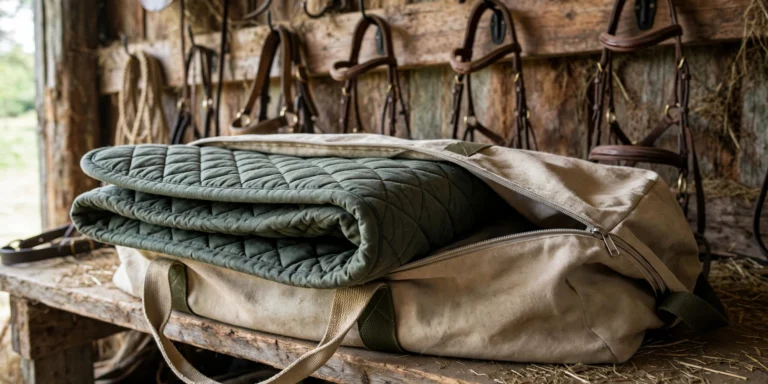
Consider a common scenario: a distributor sells a run of white show pads to tack shops ahead of competition season. The pads leave the factory folded in cartons, then sit on shop shelves and in tack rooms for weeks. By the first show, the top pads in each stack carry a film of dust and a scuffed corner or two. Nothing is wrong with the pads themselves — but the presentation reads \shopworn.\ A storage bag doesn\’t change the pad. It changes what the pad looks like when it finally meets the horse.
The short answer: storage bags protect pads from dust, scuffs, and sunlight. Buy them as an accessory line to your pads: 600D polyester for wipe-clean durability, canvas for a breathable natural feel — neither universally better. Size by pad family, ventilate for damp barns, seal for dusty travel, and add your logo with embroidery or print at 50 pieces per color.
This guide covers shell fabric choice, sizing by pad type, the breathability-versus-dust-proofing trade-off, carry hardware, and logo processes. It companions our pad sizing guide (pad dimensions by discipline, which your bag sizes must follow), our print methods guide (how logo methods behave on different fabrics), our color fastness guide (bag shell dyes need the same scrutiny as pad dyes), and our fitting clinic playbook (travel and clinic days are where riders actually use these bags).
Key takeaways
- Storage bags protect presentation — dust, scuffs, sunlight. They don\’t dry a damp pad or fix poor pad quality.
- 600D polyester vs canvas is a use-case decision, not a quality ranking. Match the shell to how the bag will be used.
- Size bags by pad family: western pads are the largest, dressage and all-purpose smaller, half pads smallest.
- Ventilation and dust-proofing trade off against each other — ventilate for damp barns, seal for dusty travel.
- Logo with embroidery on canvas or print on polyester; confirm method, size, and placement before quoting. MOQ 50 pieces per color.
What do storage bags actually protect pads from?
Direct answer: Dust settling on folded pads in tack rooms, scuffs and strap rubs during car and trailer transport, sunlight fading colors on shop displays, and compression damage in stacked storage. What a bag cannot do: dry a damp pad, or undo mildew. Storing a wet pad zipped shut makes things worse — so ventilation matters as much as coverage.
| Risk | How the bag helps | The limit |
|---|---|---|
| Tack-room dust | Solid panels keep the pad surface clean between rides | Fine dust still enters through mesh windows — the trade-off covered below |
| Transport scuffs | A sturdy shell absorbs rubs against trailer walls and car boots | Sharp hardware can still pierce a thin shell; thickness of the shell matters |
| Sunlight fading | Opaque fabric blocks the light that fades display pads | Dark bags absorb heat in direct sun — store them shaded, not on the trailer dashboard |
| Stack compression | A structured bag holds the pad\’s shape in a storage stack | Over-stuffing creases quilting; the bag should fit, not compress |
| Moisture and mildew | Breathable builds let a slightly damp pad air out | A sealed bag traps moisture — dry the pad before zipping it shut |
Notice the pattern: every protection has a matching condition. That is why bag buying is a specification exercise, not a commodity purchase — the right bag for a humid coastal barn is the wrong bag for a dusty show circuit, and the table in the next two sections is how you tell them apart.
600D polyester or canvas — which should you stock?
Direct answer: Neither is universally better. 600D polyester suits wipe-clean, hard-use travel bags; canvas suits breathable, natural-feel tack-room storage. Note what \600D\ actually names: denier is the fiber\’s linear mass density — the mass in grams of 9,000 metres of fiber — so 600D describes a yarn weight, not a guaranteed performance level. Weave, coating, and construction decide the rest.
| 600D polyester | Canvas (cotton) | |
|---|---|---|
| Typical strengths | Abrasion-resistant shell; wipes clean; a PU coating can add water resistance; holds printed logos well | Breathable; natural look and hand feel; ages well; embroiders cleanly |
| Watch-outs | Can feel plasticky; sealed builds trap moisture if pads go in damp; coatings wear with repeated washing | Heavier than polyester; absorbs water unless wax-treated; waxing changes the hand feel; cotton can mildew in damp storage |
| Best fits | Travel and show circuits; shops that wipe down displays; buyers who print bold logos | Everyday tack-room storage; brands with a natural aesthetic; buyers who embroider |
Two specification cautions. First, don\’t compare denier numbers across fiber families — the number names a yarn weight within one fiber type, and different fibers behave differently at the same denier. Second, ask what the coating is and how it was applied: an uncoated 600D shell and a PU-coated one are different products at the same denier, and the coated version is the one that resists water. Write the coating into the spec, not just the denier.
How should bag sizes map to pad types?
Direct answer: Size by the pad family the bag must hold — western pads are the largest, dressage and all-purpose smaller, half pads and numnahs smallest. One \universal\ size either swims on small pads or won\’t close on big ones, so run two to three sizes keyed to pad families, each with a few centimeters of ease around the folded pad.
The sizing method is straightforward: take the pad\’s longest dimension, its widest dimension, and its folded thickness, then add ease so the zipper closes without straining. Folded once is the standard assumption — confirm it with your factory, because a bag spec\’d for a pad folded twice is a different bag. Our pad sizing guide gives pad dimensions by discipline; your bag sizes should trace those, not a generic S/M/L chart borrowed from another product.
| Pad family | Bag approach | Notes |
|---|---|---|
| Western pads | Largest bag in the line | Near-square footprint; verify against actual pad measurements — western pads vary the most by maker |
| Dressage pads | Medium-long bag | The long flap sets the length; width can stay moderate |
| All-purpose / jumping | Medium bag | The volume driver for most English tack shops; get this size right first |
| Half pads / numnahs | Smallest bag | Often rides inside a full-size bag; a dedicated small size suits sheepskin half pads that shouldn\’t be compressed |
Order the sizes by volume, not by assumption: for most English-discipline distributors the medium all-purpose size outsells the rest, with western sizes leading only in western-heavy markets. That is a starting hypothesis — let your pad sales by discipline set the bag size ratios, and adjust by sell-through.
Breathable or dust-proof — can you have both?
Direct answer: Not fully — ventilation and sealing trade off against each other. Mesh panels or grommets let air move so a damp pad doesn\’t mildew; solid panels keep fine dust out. Match the build to the barn: humid or coastal barns want airflow, dusty arenas and trailers want sealing. Many buyers split the line — ventilated everyday bags, sealed travel bags.
The failure mode to design around is the damp pad. A rider finishes a ride, folds a sweaty pad into a fully sealed bag, and zips it shut. Days later the bag smells musty and the pad has mildew spots. No fabric choice prevents this — it is a ventilation and user-habit problem. In our experience, this single scenario generates more bag complaints than any material defect, and it is worth one line in the product hang tag: dry the pad before storing.
Combination builds split the difference honestly: a solid body with a mesh window under a storm flap gives airflow with the flap open and dust protection with it closed. Whatever the build, specify the zipper properly — a branded coil zipper that runs smoothly after a season of dust is worth more to the end user than any mesh-versus-solid debate. Zipper failure is the most common mechanical complaint on soft bags, and it is entirely a specification choice.
What carry and logo options matter at wholesale?
Direct answer: Carry hardware decides daily use: webbing carry handles for short carries, a detachable shoulder strap for the walk to the arena, an ID window or hanging loop for tack-room organization. For logos, embroidery suits canvas and reads premium; screen print or heat transfer suits polyester. Confirm logo size, placement, and color count before quoting.
| Logo method | Suits | Considerations |
|---|---|---|
| Embroidery | Canvas | Durable, premium feel; limited fine detail — confirm the stitch count and backing with the factory |
| Screen print | Polyester | Bold flat graphics; check wash durability on the actual shell fabric (see our print methods guide) |
| Heat transfer | Polyester | Fine detail possible; test adhesion on coated fabrics before committing |
| Woven label | Both | Subtle branding sewn into a seam; the lowest-risk option for a first order |
Place the logo where it survives: the bag\’s broad side panel, not the handle webbing or the zipper flap. And keep the artwork honest — a bag logo is branding, not a performance claim, so it sidesteps the claim-compliance questions that leather care labels face. One operational note: logo color count and placement should be locked before the quote, because re-quoting after artwork changes is where bag programs lose their margin.
What specs should you confirm when requesting a quote?
Direct answer: Bag quotes go wrong on the details buyers forget to specify — the zipper, the coating, the logo placement, the lining. The checklist below covers the items that separate a quotable spec from a guess, so the factory prices the bag you actually intend to sell.
- Shell fabric: fiber, denier and weave, coating type — written as a full spec, not just \600D\
- Dimensions per size, keyed to pad families and confirmed against real pad measurements
- Zipper: gauge, coil vs molded tooth, pull type, branded vs unbranded
- Handles and strap: webbing width, stitching pattern, detachable shoulder strap hardware
- Ventilation build: mesh panels, grommets, storm-flap window, or fully solid
- Logo: method, size, placement, thread or ink colors — locked before quoting
- Colorways and MOQ: 50 pieces per color per bag colorway
- Inner lining: unlined, taffeta, or quilted — matched to the protection level promised
Frequently asked questions
Can one bag size fit all pad types?
No — and the \universal\ bag is the most returned size in the category. Western pads are substantially larger than dressage pads, and a bag that swallows a western pad will swim on a half pad. Run two to three sizes keyed to pad families, and let your pad sales by discipline set the size ratios.
Should the bag be padded or quilted?
It depends on the job. Light quilting or a padded lining helps against transport scuffs — the show-travel use case. An unpadded bag breathes better, packs flat when empty, and costs less — the everyday tack-room use case. Many distributors carry both: a padded travel line and an unpadded storage line.
How do I keep stored pads from smelling musty?
Dry the pad before it goes in the bag — this matters more than any fabric choice. For barns where pads go in slightly damp, choose ventilated builds with mesh panels or grommets, and never zip a wet pad into a fully sealed bag. A musty bag is almost always a ventilation problem, not a material defect.
Do bag shell colors need fastness testing?
The same logic as pad fabrics applies: dark dyes can bleed, and sun exposure fades weak dyes. Our color fastness guide covers the test suite — apply it to bag shells, especially dark canvas that will sit in sunny tack rooms.
Can storage bags bundle with pads as a set?
Yes, and it is a natural upsell: a matching bag with a pad reads as a gift-ready set at retail. Keep the bundle honest — the bag should be sized for the pad it ships with, and the set SKU needs its own barcode. Watch the shipping cost: an oversized \kit\ bag can push the parcel into a higher freight bracket, so confirm carton dimensions before pricing the bundle.
Adding storage bags to your pad program? Send us your pad dimensions by family — we quote 600D polyester and canvas builds with your logo, sized to your pads, at 50 pieces per color MOQ.
Sources & Further Reading
- Denier (unit) (denier is the mass in grams per 9,000 metres of fiber — the definition behind \600D\)
- Saddle Pad Sizing Chart: Dressage, Jumping & Western
- Saddle Pad Print Methods Compared
- Saddle Pad Color Fastness Buyer\’s Guide
- How Tack Shops Run Saddle Pad Fitting Clinics
