
Consider a common scenario: a tack shop sells a junior rider a body protector from an old wholesale run carrying the purple 2009 label — which her governing body stopped recognizing, so she discovers at her first affiliated event that she cannot ride cross-country in it.
The short answer: A body protector is a foam vest that absorbs energy from falls, kicks, or being stepped on — and only counts for competition with a current standard. The buying variables are the BETA 2018 level (1/2/3), CE marking to EN 13158:2018, fit by chest and back length, and the replacement cycle. MOQ 50 pieces per color.
This guide covers body protector standards, protection levels, the air-vest question, sizing and fit, replacement rules, quality checkpoints, and stocking by account type. It companions our riding helmets guide, our safety stirrups guide, our riding gloves guide, and our hang tags and care labels compliance guide.
Key takeaways
- Competition acceptance is a named-standard discipline: as of January 2024, major governing bodies accept only BETA level 3 (2018) — the purple 2009 label is out.
- Certification is binary pass/fail at each level — a vest either carries the level-3 mark or it does not. Price buys fit, ventilation, and finish, not extra safety.
- Fit is a spec: chest, waist, and back length must all be right, or the vest rides up and leaves the ribs exposed.
- A body protector is PPE — treat it like PPE in buying: certificates per market, batch traceability, and a written replacement policy. MOQ 50 pieces per color.
What is a body protector, and what does it actually protect?
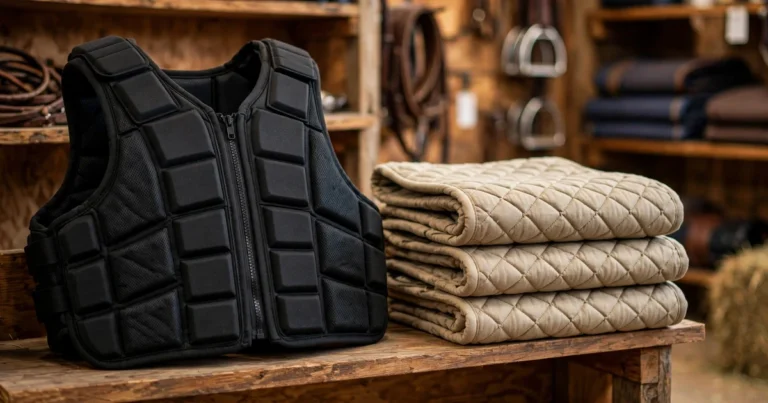
Direct answer: A body protector is a segmented foam vest worn over or under riding clothing that absorbs the energy of a fall, a kick, or being stepped on. It is designed to protect the abdomen and internal organs, the chest and ribs, and to reduce soft-tissue injuries — not to prevent spinal injury or make any fall safe.
British Eventing\’s rule-update guidance describes the mechanism plainly: the vest absorbs the high levels of energy created when a rider comes off or is kicked or stepped on, and a correctly fitted protector offers protection to the abdomen, chest, and ribs against soft-tissue injury. (British Eventing — Body Protector Rule Update) The \correctly fitted\ qualifier carries most of the sentence\’s weight: a vest that rides up at the waist protects nobody\’s ribs.
The realistic expectation to set at the counter: body protectors reduce the severity of certain injuries; they do not eliminate risk. Staff should say this out loud to every buyer, and the shelf card should say it in print.
What are the current body protector standards?
Direct answer: The current standard is BETA 2018, with three protection levels marked by colored labels — Level 1 (green), Level 2 (orange), Level 3 (blue). The European norm is EN 13158:2018, and CE marking to it means annual retesting to the BETA 2018 standard. The 2009 standard (purple label) is no longer recognized by governing bodies.
Horse & Hound\’s standards explainer gives the timeline: the BETA standard was developed by the British Equestrian Trade Association with riding organizations, doctors, riders, manufacturers, and retailers, revised in 2009 and again in 2018 — and as of 1 January 2024, major governing bodies accept only the BETA level 3 (2018) version. (Horse & Hound — Body Protector Standards Explained) The 2009 purple label stopped being manufactured in 2018, and most governing bodies ceased recognizing it at the end of 2023.
On the CE mark, two points from the same source. A CE mark is not a quality mark — it shows the product is fit for purpose under personal protective equipment rules. And CE marking to EN 13158:2018 means annual retesting to the BETA 2018 standard, which keeps the certification current. For the importer, that means the certificate has a date and a retest cycle — ask for the current one.
Which BETA level suits which rider?
Direct answer: Level 3 (blue label) is the level for general riding and competing — it is the highest protection of the three and the only one most governing bodies accept. Level 2 (orange) suits low-risk situations only, and Level 1 (green) is considered appropriate only for licensed jockeys while racing.
| Level | Label color | Intended use — per the standard |
|---|---|---|
| Level 3 | Blue | General riding and competing — the level governing bodies require for disciplines like eventing cross-country; designed to reduce soft-tissue injuries and prevent some rib fractures |
| Level 2 | Orange | Low-risk situations only — explicitly not jumping, not road riding, not young or excitable horses, not inexperienced riders |
| Level 1 | Green | Licensed jockeys while racing only — the lowest protection of the three |
For the wholesale buyer, the practical consequence is inventory focus: the vast majority of riders should be in Level 3, which makes Level 3 the depth line and the other two levels special-order territory.
Note what the standard does not do: it does not rank individual vests within a level. Every Level 3 vest passed the same Level 3 tests — which is why \which is the safest body protector\ is the wrong buying question.
Body protector vs air vest: what should distributors know before stocking?
Direct answer: Foam body protectors and air vests are different technologies answering the same rider need — one absorbs energy through certified foam panels, the other inflates on separation from the saddle. The certified foam vest is the baseline every competition rulebook recognizes; treat air vests as the premium add-on line.
The buying logic runs in three parts. First, the foam body protector is the product with the named standard — BETA 2018, EN 13158:2018 — which is what stewards check at the in-gate. Second, air vests add inflation-triggered protection on top of (not instead of) the foam baseline in most competition contexts. Third, rule wording varies by governing body, so any claim about competition acceptance must be checked against the current edition per market.
Stocking guidance, conditional: for most tack shops, the foam Level 3 line is the depth assortment and the air vest is the single-SKU premium add-on for the eventing and jumping customer. Do not let the air vest cannibalize the foam line.
How do body protectors get sized and fitted?
Direct answer: Body protectors size by chest circumference, waist, and back length — all three, from the maker\’s own size chart, because there is no universal body-protector size standard. The fit check is functional: the vest must cover the ribs and sternum, stay put when the rider moves, and not ride up at the waist.
Three fitting points the staff should check on every sale. Back length: with the rider seated in riding position, the back panel should end above the saddle\’s cantle. Chest and waist: the vest should close per the maker\’s design, snug enough not to rotate, loose enough to breathe. Shoulder and arm: the armholes must clear the rider\’s arms for rein contact.
The junior program deserves its own fitting discipline. Growing riders outgrow vests — recheck back length and chest closure each season. For wholesale, adjustability (lace or elastic side panels) is the key junior-line feature.
When should a body protector be replaced?
Direct answer: After any significant impact, and on a calendar cycle even without one — Horse & Hound\’s standards guidance recommends replacing a body protector every three to five years, because foam degrades with age, sweat, heat, and compression regardless of whether it has \done its job\ in a fall.
Two replacement triggers, and they are independent. The impact trigger: any fall where the vest absorbed energy, any kick, any visible foam compression, cracking, or deformation — the vest is retired, not inspected back into service. The calendar trigger: the three-to-five-year recommendation stands even for the vest that has never been fallen in, because heat, UV, sweat, and daily compression age the foam.
The third trigger is the standards change. When a governing body stops recognizing an old standard, as happened to the purple 2009 label at the end of 2023, every vest carrying it becomes unusable for affiliated competition. Check each target market\’s governing-body standards page once a year, before the season\’s first order.
What quality checkpoints should importers inspect?
Direct answer: Certification labeling, foam panel integrity, closure function, stitching and binding, and size-marking accuracy — in that order. Body protectors are personal protective equipment, so the inspection treats label fraud and foam defects as critical failures, never as negotiable flaws to be discounted through.
| Checkpoint | What to look for | Why it matters |
|---|---|---|
| Certification labeling | Correct BETA level label (blue for Level 3) sewn in per model; CE mark with EN 13158:2018 reference; label matches the certificate supplied for that exact model | A vest with the wrong label is a compliance failure at the in-gate — and a liability failure everywhere else |
| Foam panel integrity | Panels uniform in thickness, no cracks, crumbling, or compressed dead spots; segmentation channels even | The foam is the protection — a cracked or compressed panel is a vest that has already failed |
| Closures and adjusters | Front zip runs smoothly full length; side laces, straps, or elastic adjusters hold under tension; hook-and-loop closes firmly | A vest that cannot be closed snugly cannot stay in place on impact |
| Stitching and binding | Panel pockets fully closed with even stitching; binding continuous around edges; no skipped stitches at curves | Open pockets let panels migrate; migrated panels leave gaps in coverage where the ribs are |
| Size marking | Size marked legibly and matching the maker\’s chart; left-right symmetry of the cut | Wrong size marking guarantees mis-fitted riders — the fit failure starts in the warehouse |
Require the current BETA/CE certificate per model before bulk production, and match the label in the bulk shipment to the certificate.
How should tack shops stock body protectors?
Direct answer: Stock Level 3 as the depth line in the sizes your customers\’ bodies actually come in, keep junior adjustables as the growth line, and treat air vests and Level 1/2 as special-order or single-SKU lines. These are starting hypotheses — adjust by your own sell-through.
| Account type | Starting hypothesis | Watch for |
|---|---|---|
| Eventing / jumping shop | Deep Level 3 adult range across chest sizes with short/regular/tall back lengths; junior adjustable line; one air-vest SKU as the premium add-on | Keep the current standard edition printed at the counter and train staff on the blue-label requirement |
| General mixed tack shop | Level 3 adult line in the middle sizes; junior line for the lesson-rider parents; fit service as the differentiator | The shop that fits sells the vest and keeps the customer |
| Riding school / lesson barn | Fleet of adjustable Level 3 vests in junior and small-adult sizes; buy on adjustability, washable covers, and closure durability | School vests take daily abuse — budget replacements on the calendar cycle, not on failure |
| Online-first retailer | Narrow Level 3 range with the maker\’s full size chart on every product page; clear returns policy for fit exchanges | Online buyers can\’t try the vest — the size chart does the fitting, so it must be the maker\’s real chart |
What specs should you confirm when requesting a quote?
Direct answer: Make the four things buyers assume explicit: the certified protection level, the markets the certification covers, the size-run conventions, and the replacement/retest documentation behind them. A \black body protector, size M\ can be three different compliance situations depending on the answers.
- Certification: BETA 2018 level per model (Level 3 blue for competition lines), CE marking to EN 13158:2018, notified body, and current certificate copies
- Market coverage: which governing bodies\’ rulebooks the certification is checked against, and the edition date of each check
- Construction: foam type and panel layout, segmentation pattern, outer fabric and mesh spec, closure type with durability rating
- Sizing: full size chart per model — chest, waist, and back length per size, including junior adjustability range
- Labeling: exact label artwork per level, sewn-in placement, care-label language per destination market
- Retest and traceability: annual retest schedule to BETA 2018, batch/lot marking for traceability, foam-supplier change notification clause
- Packing: pieces per carton, carton dimensions and weight, individual polybag with fit-and-replacement insert
- Colorways and MOQ: 50 pieces per color; each protection level and each model counted as a separate line for MOQ purposes
Frequently asked questions
Is a more expensive body protector safer than a cheaper one?
Not within the same certification level — every Level 3 vest passed the same Level 3 tests. Price buys fit range, ventilation, lighter weight, and finish. The safety question is binary: does it carry the current level-3 mark, and does it fit.
Can a rider compete in a 2009-standard body protector?
Not where the rulebook requires the current standard. Major governing bodies stopped recognizing the purple 2009 label at the end of 2023, and British Eventing requires Level 3 blue BETA 2018 from 1 January 2024.
Does an air vest replace a foam body protector?
Treat them as different technologies, not substitutes: the foam vest carries the named competition standard; the air vest is the premium add-on worn over it. Confirm the exact rule wording per governing body before making claims about the in-gate.
How do you know when a body protector needs replacing?
Three triggers: any significant impact or visible foam damage retires it immediately; the calendar recommendation is every three to five years even without a fall; a standards change can retire a whole label generation overnight.
What size body protector should a shop recommend?
The one that fits all three measurements — chest, waist, and back length — on the maker\’s own chart, with the back panel ending above the cantle in riding position. There is no universal size standard.
Adding body protectors to your program? Send us your target levels, size runs, and markets — we quote at 50 pieces per color.
Sources & Further Reading
- Horse & Hound — Body Protector Standards for Horse Riders Explained (BETA standard history 2000/2009/2018; level 1/2/3 uses and label colors; EN 13158:2018 annual retest; purple 2009 label no longer recognized; three-to-five-year replacement recommendation)
- British Eventing — Body Protector Rule Update (Level 3 blue BETA 2018 required from 1 January 2024; purple 2009 no longer permitted; mandatory for cross-country and arena eventing over solid fences)
- Riding Helmets: A Wholesale Buyer\’s Guide
- Safety Stirrups: A Wholesale Buyer\’s Guide
- Riding Gloves: A Wholesale Buyer\’s Guide
- Saddle Pad Inventory Planning for Tack Shops
