
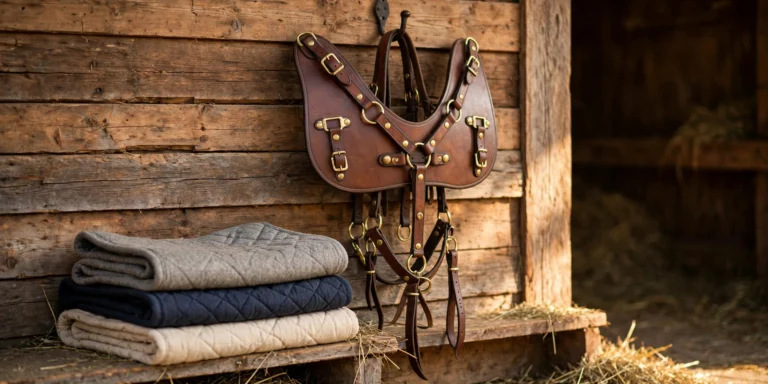
Consider a common scenario: a distributor adds breastplates to a saddle-pad reorder, and part of the shipment comes back within the season. The complaints are specific — elastic that goes slack after weeks of use, buckles that slip under load, hardware that corrodes and stains light-colored horses — while the original specification was vague. Breastplates and martingales look simple next to a quilted saddle pad, but they are fitting equipment. When the specification is vague, the returns are specific.
This guide covers the types distributors actually sell, how to specify materials and hardware with numbers, the sizing logic, the QC checkpoints that keep fitting equipment out of the returns bin, and the spec list to send when requesting a quote.
Key takeaways
- Breastplates (hunting, elastic, 5-point) and martingales (running, standing) are distinct products with different buyers — stock them as separate lines, not one \breastplate\ SKU.
- Elastic is the make-or-break specification: specify elastic type, stretch, and recovery on the tech pack, not just \elastic breastplate\ — and re-test on bulk, since elastic is the component most likely to be silently substituted.
- Specify hardware by base metal (solid brass or stainless steel), not by finish color; plated hardware is a frequent quality complaint in our experience.
- Size by horse (cob, full, oversize) with published measurements — \one size\ breastplates fit nobody well.
- Leather and synthetic tiers serve different customers at different price points; which tier carries better margin or volume depends on your market and spec cost, not on a fixed ranking.
What are breastplates and martingales?
A breastplate runs from the saddle\’s D-rings forward between the front legs and over the neck to stop the saddle sliding back. A martingale runs from the girth between the front legs and connects to the reins (running martingale) or the noseband (standing martingale) to influence head carriage. They share materials, hardware, and buyers — which is why distributors stock them together — but riders buy them for different jobs, so specify and stock them as separate lines.
Which types should a distributor stock?
Five types cover the category: hunting, elastic, and 5-point breastplates, plus running and standing martingales. In our experience, hunting breastplates and running martingales move the most units because they serve the broadest rider base, while the 5-point is the premium tier with the most demanding specification. The table maps each type to its buyer and its specification focus.
| Type | Use | Buyer | Specification focus |
|---|---|---|---|
| Hunting breastplate | General saddle stability | Hunter/jumper riders | Strap width, elastic section, leather quality |
| Elastic breastplate | Comfort + stability | Everyday riders, eventers | Elastic stretch/recovery — the critical spec |
| 5-point breastplate | Maximum stability, jumping | Eventers, show jumpers | Ring and strap geometry, sheepskin lining option |
| Running martingale | Rein control with freedom | Jumpers, trainers | Ring size, rein stops, neck strap adjustment |
| Standing martingale | Head carriage limit | Hunters, flatwork riders | Strap length range, noseband attachment |
Start the category with hunting breastplates and running martingales, then add the 5-point as the premium tier once the base lines move. Two sourcing notes worth knowing before you split the first order: whether the 5-point or the leather tier carries better margin depends on your spec cost and price positioning — premium spec only pays when the selling price supports it. And whether synthetic outsells leather on volume varies by market: schooling and eventing programs lean toward synthetic, traditional hunter barns lean toward leather. Ask where your existing pad customers fall before deciding the split.
How do you specify materials and hardware?
Specify three things with numbers: the strap material and width, the elastic\’s stretch and recovery, and the hardware\’s base metal — not its finish color. Vague words like \good quality elastic\ or \brass hardware\ are where substitutions hide. The details below tell you what to put on the tech pack instead.
Leather vs synthetic. English leather serves the traditional hunter market and higher price points; synthetic webbing and biothane-style coated materials serve the eventing, schooling, and wet-climate markets where easy care matters. Most distributors carry both tiers because they reach different customers — but the split should follow your buyers, not a fixed rule. Watch which tier your existing saddle-pad customers buy; it predicts the breastplate split.
Elastic. \Elastic breastplate\ is not a specification — elastic varies enormously in stretch, recovery, and lifespan, and elastic that doesn\’t recover becomes a loose, useless strap within a season. Specify the elastic type, the stretch percentage at working load, and the recovery requirement; ask the factory what elastic it uses and approve the pre-production sample with a stretch-cycle test — stretch to working length, release, and measure the length it keeps after repeated cycles. Put both the elastic spec and the stretch test on the tech pack and the inspection checklist.
Hardware. Buckles, D-rings, snaps, and rein rings should be specified by base metal: solid brass or stainless steel. Plated hardware — base metal with a thin brass-colored coating — is a frequent quality complaint in our experience: the plating wears, the base metal corrodes, and green stains appear on light-colored horses. Write the hardware material explicitly on the tech pack and check it on samples with a scratch test through the finish.
How does sizing work?
Size by horse: cob, full, and oversize are the standard breaks. Publish the actual measurements — neck strap length range, girth attachment length, and martingale fork length, in centimeters and inches — because riders buy fitting equipment by numbers. \One size fits all\ is a returns generator: a cob-sized neck strap on a 17-hand warmblood either doesn\’t fit or fits badly.
- Publish measurements. Neck strap length range, girth attachment length, and martingale fork length, in centimeters and inches.
- Check adjustment range. The holes and buckles must cover the full stated range — a \full\ size whose longest hole setting still runs short is a mislabeled product.
- Size the elastic section. On elastic breastplates, the elastic portion\’s length at rest and at stretch both matter; too much elastic and the breastplate does nothing, too little and it\’s just a leather strap.
What are the QC checkpoints?
Treat breastplates and martingales as safety equipment at inspection: the D-ring and buckle attachments carry load. Check stitching, elastic recovery against the approved standard, hardware material and function, edge finishing, and cutting symmetry — and re-test the components most likely to be substituted between sample and bulk. Our pre-shipment QC checklist covers the general inspection method; the checkpoints below are category-specific.
- Stitching. Box stitching at stress points (D-ring attachments, buckle ends), even stitch length, no skipped stitches. Pull-test the D-ring attachments.
- Elastic performance. Stretch-recovery test on every shipment\’s samples against the approved standard. Elastic is the component most likely to be silently substituted between sample and bulk.
- Hardware. Material check (scratch test), buckle function (tongue seats properly, doesn\’t slip under load), snap spring strength, no sharp edges on rings.
- Edge finishing. Leather edges dyed and sealed, synthetic edges heat-sealed or bound. Rough edges chafe the horse and look cheap at retail.
- Symmetry. Lay the breastplate flat — straps should be mirror-symmetric. Asymmetric cutting is a common factory shortcut that riders notice immediately when fitting.
- Sheepskin lining (5-point models). If lined, check the sheepskin density and attachment — glued-only lining peels; stitched lining lasts.
What do you need to request a quote?
A quote request that gets an accurate price lists the product type, material tier, sizes with measurements, hardware material, branding method, quantities per color, packaging, and target delivery date. The checklist below is what our factory needs — send it filled in and the first quote round usually needs no clarification.
- Product type and style (e.g. hunting breastplate, 5-point with sheepskin lining, running martingale)
- Material tier: leather (specify grade) or synthetic (specify webbing/coating)
- Sizes: cob / full / oversize with published measurements, plus quantity split per size
- Hardware: base metal (solid brass or stainless steel) and finish
- Elastic specification: type, stretch percentage, recovery requirement
- Branding: embossed logo plates, woven labels, or custom packaging
- Quantities per color — our standard is 50 pieces per color for custom programs
- Packaging requirements (individual polybag, hang tag, retail box)
- Target delivery date and freight terms
Frequently asked questions
What is the difference between a breastplate and a martingale?
A breastplate keeps the saddle from sliding back; a martingale influences the horse\’s head position through the reins or noseband. They attach at similar points on the girth, which is why they\’re sold together, but they solve different problems. A rider may need one, both, or neither — merchandise them as complementary lines, not interchangeable ones.
Do standing martingales sell as well as running martingales?
It depends on the discipline mix of your market. Under the FEI Jumping tack rules, standing martingales are permitted only in warmup and training arenas, while running martingales are permitted in the competition arena — so distributors selling to competitive jumpers should expect running martingales to dominate. Check your national federation\’s rulebook for the disciplines you serve before weighting the assortment.
What is the typical MOQ for breastplates?
Our standard is 50 pieces per color for custom programs, consistent with our saddle-pad MOQ — see our MOQ and lead-time guide for how the economics work. Stock programs in standard colors can sometimes be consolidated across types to reach workable quantities — confirm the exact structure with the factory when you send your target list.
Can breastplates be private-labeled like saddle pads?
Yes. Embossed logo plates on leather, woven labels on synthetics, and custom packaging all work the same way as our saddle-pad branding program. Hardware can also be finished to match a brand\’s existing line — confirm the finish options during sampling.
Sources & Further Reading
- FEI Jumping Tack and Equipment Requirements — Article 5 covers martingales and breastplates: permitted types, the one-martingale-stopper-per-rein rule, and the warmup-only restriction on standing martingales.
- How to Brief a Factory for Custom Saddle Pads — the tech-pack method that applies equally to breastplates and martingales.
- Pre-Shipment QC Checklist for Saddle Pads — the general inspection workflow behind the category-specific checkpoints above.
Breastplates and martingales reward the same discipline as saddle pads: numbered specifications, tested elastic, honest hardware, and published sizing — and they ride the same container as your pad reorders, which makes them a strong line extension for a tack distributor. Send your target types, sizes, and material tier, and we\’ll quote them at our standard 50-pieces-per-color MOQ with the elastic and hardware specifications locked on the tech pack before sampling begins.
